
In trade negotiations, as in chess, sometimes you need to accept a temporary disadvantage to secure a better long-term position, points out Sonal Varma, chief economist (India and Asia ex-Japan) at Nomura.

United States President Donald Trump has warned that countries aligning with the BRICS economic bloc will face additional 10 per cent tariffs on their goods, as he seeks to protect the dollar's global dominance.

The liquidity in the banking system moved into surplus almost after three months as the Reserve Bank of India (RBI) absorbed over Rs 40,000 crore from the market on Monday, predominantly on the back of increased government spending. However, this situation may be short-lived given the higher demand for funds to pay taxes and year-end targets, treasury executives said. Meanwhile, two variable reverse repo rate (VRRR) auctions held on Tuesday received weak response.

From the 30 Sensex firms, Tata Consultancy Services and HCL Technologies dropped over 3 per cent each. Infosys, Tech Mahindra, Sun Pharma and Tata Motors were the other major laggards. Bajaj Finance, Bajaj Finserv, Nestle, HDFC Bank, ICICI Bank and State Bank of India were among the biggest gainers.

Shares of state-owned bank stocks were under pressure on Monday due to muted deposit and credit growth numbers reported by these lenders in the October-December quarter (Q3) of 2024-25 (FY25). The Nifty PSU Bank index was down 4 per cent, with Union Bank of India emerging as the biggest loser as its shares fell 7.5 per cent to close at Rs 114.7, followed by a 5.7 per cent drop in shares of Bank of Baroda (BoB) to Rs 228 and a 4.7 per cent slide in shares of Bank of India to Rs 99.8 on the National Stock Exchange.

The Reserve Bank of India said on Tuesday it has raised the limit for short-term advances to state governments by nearly 19 per cent to Rs 71.70 billion from Rs 60.35 billion.

About 55 banks participated in the deal, making it the largest bank group for a syndicated loan in Asia so far this year.

The Reserve Bank of India (RBI) on Wednesday came out with comprehensive draft guidelines to harmonise and regulate gold loans across all financial entities, including putting a cap of 75 per cent on loan-to-value (LTV) ratio. The draft guidelines also aim to address concerns related to certain lending practices, provide clarity on specific aspects, and strengthen the conduct-related standards in the sector.

It is to be seen if SBI under Setty, who will have a three-year term, can ride the economic cycle to take SBI to new heights, navigating some of these challenges.
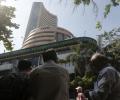
From the Sensex pack, Larsen & Toubro, Bajaj Finserv, Mahindra & Mahindra, UltraTech Cement, State Bank of India, IndusInd Bank, Reliance Industries and Sun Pharma were among the biggest gainers. Bharti Airtel, Titan, ITC, Kotak Mahindra Bank, Tech Mahindra and HDFC Bank were among the laggards.

Saurav Ghosh's step-by-step guide will help you understand what bonds are, how they help investors make money, how much money they make and which bonds to invest in.

The banking system neared Rs 1.47 trillion of liquidity deficit on Monday, the highest since January 29, 2020, when the banking system liquidity deficit went up to Rs 3 trillion. The Reserve Bank of India (RBI) injected Rs 1.47 trillion on Monday and Rs 1.46 trillion on Tuesday. Market participants say that the disbursement of Rs 25,000 crore as the second tranche of incremental cash reserve ratio (I-CRR) will not be enough, and the liquidity might tighten further to Rs 2 trillion in short term due to tax outflows and arrival of the festival season.

Experts say the state's economy is grappling with hidden debt, rising welfare costs, and lack of transparency.

Finance Minister Nirmala Sitharaman on Wednesday asked fintech startups to come out with solutions to deal with the rising incidence of digital arrests, cheating by fly-by-night operators, and other kinds of cyber frauds. Speaking at the Digital Payments Awards 2025 ceremony here, the minister credited fintechs with helping speed up financial inclusion and taking the payment system to even the far-flung areas of the country.

The central bank has, so far, cut its repo rate by 125 bps.

It won't be easy for the banking sector to better its performance every quarter, predicts Tamal Bandyopadhyay.

Sebi's probe against Jane Street is part of its efforts to mitigate losses for individual derivative traders.
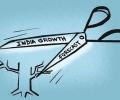
The GDP growth is expected to be about 6.3 per cent in the current fiscal year, a tad lower than the government's estimate of 6.4 per cent, owing to several factors such as weak demand, SBI research report said on Wednesday. According to the first advance estimates (FAE) of National Income for 2024-25 released by the National Statistics Office (NSO), released on Tuesday, India's economic growth rate is estimated to slip to a four-year low of 6.4 per cent in 2024-25, because of poor showing by the manufacturing and subdued investments.

The banking system's liquidity slipped into deficit for the first time in the current financial year (2023-24) due to the imposition of the Incremental Cash Reserve Ratio (I-CRR) for banks and outflows from goods and services tax (GST) payments, according to dealers. Reserve Bank of India (RBI) data shows it injected Rs 23,644 crore on August 21. The last time liquidity was in deficit was on March 27, when the RBI injected Rs 45,575 crore.
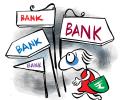
'One way of doing this could be offering credit guarantee to the banks, say 10 per cent, for fresh loans given to micro, small and medium enterprises,' observes Tamal Bandyopadhyay.
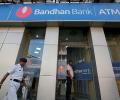
It is 10 years since Bandhan Financial Services became the first microfinance institution (MFI) to receive the universal bank licence. A year later, in 2015, it started operations. Bandhan's entry into banking was seen as a vote of confidence by the Reserve Bank of India (RBI) for the country's microfinance sector. Subsequently, the RBI awarded small finance bank licences to nine MFIs.
State-run IDBI Bank expects interest rates, both on deposits and advances, to increase from the third quarter of the current financial year.

The drop in net interest margin will separate the men from the boys, explains Tamal Bandyopadhyay.

Benchmark equity indices Sensex and Nifty slumped over 1 per cent on Friday, tracking a weak trend in global markets and fresh foreign fund outflows. Falling for the third day running, the 30-share BSE Sensex tumbled 1,017.23 points or 1.24 per cent to settle at 81,183.93.

Public sector banks have raked in more profits in the three months ended June on the back of a persistent decline in bad loans and the trend may have a positive bearing on their balance sheets in the coming quarters. In the June quarter, Bank of Maharashtra (BoM) and State Bank of India (SBI) were in the lowest quartile as far as Gross Non Performing Assets (NPAs) and net NPAs were concerned, according to an analysis of the quarterly financial numbers published by the public sector lenders. Cumulatively, all the 12 public sector banks reported a profit of about Rs 15,306 crore in the three months ended June, registering an annual growth of 9.2 per cent. However, leading public sector lenders -- SBI and PNB -- posted lower profits in the June quarter.

The bank added that with the inflation trending down -- consumer price inflation for August eased to 7.80 per cent -- the rate adjustment will continue to ensure that the depositors are compensated 'adequately with a positive real rate on their deposits.'

SBI last reduced its lending rate in January by cutting it by 0.05 per cent.

Ruling out any immediate rise in lending rates, the State Bank of India said it will wait for the Reserve Bank of India's policy meeting on April 20 before taking a decision on rates for deposits and advances. SBI is India's largest bank.

In response to the panic triggered by Trump's trade policies, the RBI net sold approximately $43 billion in the second half of FY25 to curb volatility, as the rupee plunged to a low of 87.95 per dollar in February this year.

Sensex eneded 374 points higher on rate cut expectation from the RBI.

The ongoing fourth quarter earnings season, global factors and macroeconomic data would guide the trends in the equity markets this week, analysts said. Markets would also take cues from trading activity of foreign investors, rupee-dollar trend and movement of global oil benchmark Brent crude. "Domestically, the next batch of Q4 earnings reports will drive stock-specific movements, Hero MotoCorp, Larsen & Toubro, BPCL, State Bank of India, Eicher Motors and Tata Motors are some of the big names in the list and the next phase of voting," said Pravesh Gour, senior technical analyst, Swastika Investmart Ltd.
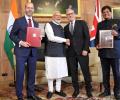
India and the UK on Thursday inked a landmark free trade agreement (FTA) that will cut tariffs on British whisky, cars and an array of items, besides boosting bilateral trade by around $34 billion annually.

The week's losses wiped out investor wealth worth Rs 18.43 trillion, with the total market capitalisation of BSE-listed firms now at Rs 441 trillion.

Among Sensex firms, HDFC Bank climbed more than 2 per cent. TCS, Maruti, Infosys, Reliance Industries and Bharti Airtel were among the major gainers. State Bank of India, JSW Steel, ITC, Tata Motors, UltraTech Cement and Nestle were among the laggards.

Travel is about making memories, experiencing the unknown, and engaging in new experiences -- not worrying about fluctuating exchange rates or hidden expenditures. With a little planning and a proactive approach to handling your foreign exchange, you can reduce financial stress and enjoy your trip, suggests Pavan Kavad.

The Trump trade shock is a chance to push long-overdue reforms, rather than tinker with tariffs to appease the US, suggests M Govinda Rao.

Banks will also consider requests from MSMEs for restructuring their stressed standard assets. So far, only 25 per cent of the around 1 million eligible MSMEs have taken benefit of the RBI's special dispensation.

India's economic growth prospects should remain strong over the medium term, with GDP expanding 6-7.1 per cent annually in fiscal years 2024-2026, S&P Global Ratings said on Thursday. In a report titled 'Global Banks Country-By-Country Outlook 2024', S&P said the banking sector's weak loans will decline to 3-3.5 per cent of gross advances by March 31, 2025, on the back of structural improvement, including healthy corporate balance sheets, tighter underwriting standards and improved risk-management practices. Interest rates in India are unlikely to rise materially, and this should limit the risk for the banking industry, it added.

Benefitting from the economic rebound, banks are expected to report a healthy bottom-line and asset quality profile in the quarter ended March 2023 (Q4FY23). The net profit of listed commercial banks is projected to grow by an average 43.6 per cent year-on-year (YoY) in Q4FY23 amid better net interest margins (NIMs) and declining credit costs. This is based on a combined assessment of analyst estimates for 17 banks on Bloomberg database.
Among the Sensex firms, NTPC, Power Grid, Mahindra & Mahindra, Larsen & Toubro, Sun Pharma, State Bank of India, Titan and Tata Steel were the major gainers. Tata Consultancy Services, Infosys, Axis Bank, Bajaj Finserv, UltraTech Cement and Bajaj Finance were the major laggards.
